

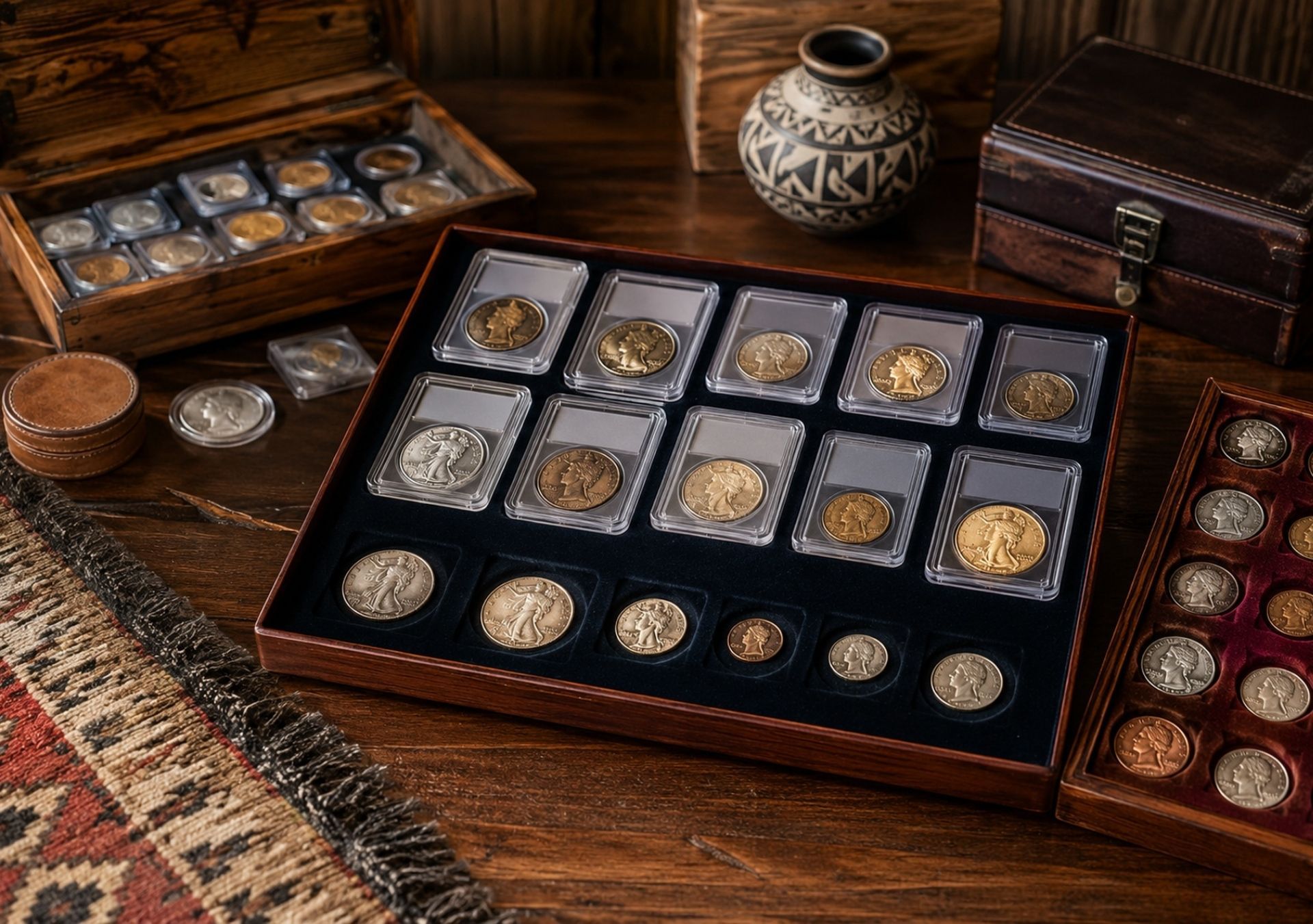
A single 1794 Flowing Hair silver dollar sold for over $10 million a few years back. Even modest collections of Morgan dollars, gold eagles, or Texas Republic-era coins can represent tens of thousands in value sitting inside a home safe. Yet most Texas collectors don't realize their
homeowners policy treats those coins the same way it treats loose change in a junk drawer. If you're building or maintaining a coin collection in Texas, understanding your insurance coverage options isn't optional; it's essential protection for years of careful acquisition. This overview of coin collection insurance coverage for Texas collectors breaks down what standard policies miss, what specialized options exist, and how the state's unique geography and legal landscape affect your decisions. With Texas House Bill 1056 set to
officially recognize gold and silver specie as legal tender starting September 1, 2026, the intersection of numismatics and insurance in this state is shifting in real time.
Understanding Homeowners Insurance Limitations for Texas Numismatists
Your homeowners or
renters policy does cover
personal property, including coins. The problem is how much it covers and under what conditions. Most Texas collectors discover these gaps only after a loss, and by then it's too late.
Standard Policy Sub-limits on Money and Precious Metals
A typical HO-3 homeowners policy in Texas includes a special sub-limit for "money, bank notes, bullion, and related items." That cap usually sits at $200 to $300 total. Not per coin, not per type: total. If a house fire destroys your collection of 50 American Silver Eagles worth $1,800, you're looking at a reimbursement check for $200. That's not a typo.
Some policies lump coins in with other "high-value" categories like
jewelry and furs, which might raise the sub-limit to $1,000 or $1,500. But even that number is meaningless for a serious collection. The sub-limit applies regardless of your overall personal property coverage amount, so having a $300,000 contents limit on your policy doesn't help your coins one bit.
Common Exclusions: Market Appreciation vs. Face Value
Here's where things get even more frustrating. Standard policies that do pay out on coin losses often base the payout on face value or actual cash value, not collector or numismatic value. Your 1909-S VDB Lincoln cent has a face value of one penny. Its market value in 2026 ranges from $1,200 to over $2,000 depending on grade. Guess which number your basic policy uses.
Market appreciation, rarity premiums, and grading condition are invisible to a standard homeowners claim. Policies also commonly exclude "mysterious disappearance," meaning if a coin vanishes from your collection without evidence of theft or a covered peril, you get nothing. For collectors who handle, display, and transport coins regularly, this exclusion creates a dangerous blind spot.

Once you understand what your homeowners policy won't do, the next step is finding coverage designed for collectors. Three main options exist, each suited to different collection sizes and habits.
Scheduled Personal Property Endorsements
A scheduled personal property endorsement (sometimes called a floater) attaches to your existing homeowners policy. You list each high-value coin or set individually, along with its appraised value. The insurer agrees to cover that specific item for that specific amount.
The upside: you get agreed-value coverage, meaning no depreciation arguments during a claim. The downside: every new acquisition needs to be added to the schedule, and you'll need updated appraisals every two to three years. Annual premiums typically run $1 to $3 per $100 of insured value. For a $50,000 collection, expect to pay $500 to $1,500 per year.
Blanket Policies for High-Volume Collections
If your collection includes hundreds or thousands of coins, scheduling each one individually becomes impractical. Blanket coverage insures your entire collection under a single total value. You might carry a $100,000 blanket policy that covers all coins in your possession without itemizing each piece.
The catch is that blanket policies often cap per-item payouts. A $100,000 blanket policy might limit any single coin's claim to $5,000 or $10,000. If your collection includes a few standout pieces worth significantly more, you'll want to schedule those separately while keeping the blanket for everything else.
Standalone Inland Marine Insurance for Collectors
Inland marine insurance originated to cover goods in transit, but it's evolved into the go-to policy type for valuable collectibles. Standalone inland marine policies from specialty insurers offer broader coverage than endorsements, including protection against accidental breakage, mysterious disappearance, and loss during transit.
Companies specializing in collectibles insurance often understand numismatic valuation better than general homeowners carriers. They're more likely to accept professional grading reports from PCGS or NGC as proof of value. Premiums vary, but standalone collector policies often cost less per dollar of coverage than endorsements on a homeowners policy, especially for collections exceeding $25,000.
| Coverage Type | Best For | Per-Item Limits | Mysterious Disappearance | Typical Cost per $100 |
|---|---|---|---|---|
| Homeowners Sub-limit | No serious collection | $200-$300 total | Not covered | Included in premium |
| Scheduled Endorsement | Small, high-value sets | Agreed value per item | Usually covered | $1-$3 |
| Blanket Policy | Large-volume collections | Capped per item | Varies | $0.80-$2 |
| Standalone Inland Marine | Serious collectors | Agreed or blanket | Typically covered | $0.50-$1.50 |
Texas-Specific Risk Factors and Mitigation
Texas presents a unique combination of environmental threats that directly affect how you store and insure a coin collection. Your geographic location within the state changes your risk profile significantly.
Protection Against Natural Disasters: Wind, Hail, and Flooding
Texas leads the nation in severe weather insurance claims. Hailstorms in the Dallas-Fort Worth metroplex, hurricanes along the Gulf Coast from Galveston to Corpus Christi, and tornadoes across the Panhandle all pose real threats to home-stored collections. One thing to keep in mind: standard homeowners policies in Texas often carry separate wind and hail deductibles, sometimes 1% to 2% of the dwelling value. That means you could face a $4,000 deductible before any personal property coverage kicks in.
Flood damage is excluded from virtually every homeowners policy. If your collection is stored in a ground-floor safe in a Houston-area home, a single tropical storm could wipe it out with zero coverage. The National Flood Insurance Program covers personal property up to $100,000, but coins fall under the same restrictive sub-limits as your homeowners policy. Specialized collector policies handle flood damage far more effectively.
Safe Storage Requirements and Humidity Control in Gulf Coast Climates
Most insurers offering collector-grade coverage require specific storage conditions. A UL-rated safe bolted to the floor is a baseline expectation. Some policies mandate a bank safe deposit box for items above a certain value threshold, though this creates its own complications since FDIC insurance doesn't cover safe deposit box contents.
Texas Gulf Coast humidity regularly exceeds 80%, and that moisture is a coin's enemy. Copper and bronze coins develop verdigris, while silver tones unevenly. Insurers may deny claims if improper storage contributed to damage. Invest in a climate-controlled storage area with stable temperature between 65 and 70 degrees Fahrenheit and relative humidity near 40%. Silica gel canisters inside safes help, but a dedicated HVAC system with backup power is the real solution for collections worth $50,000 or more.
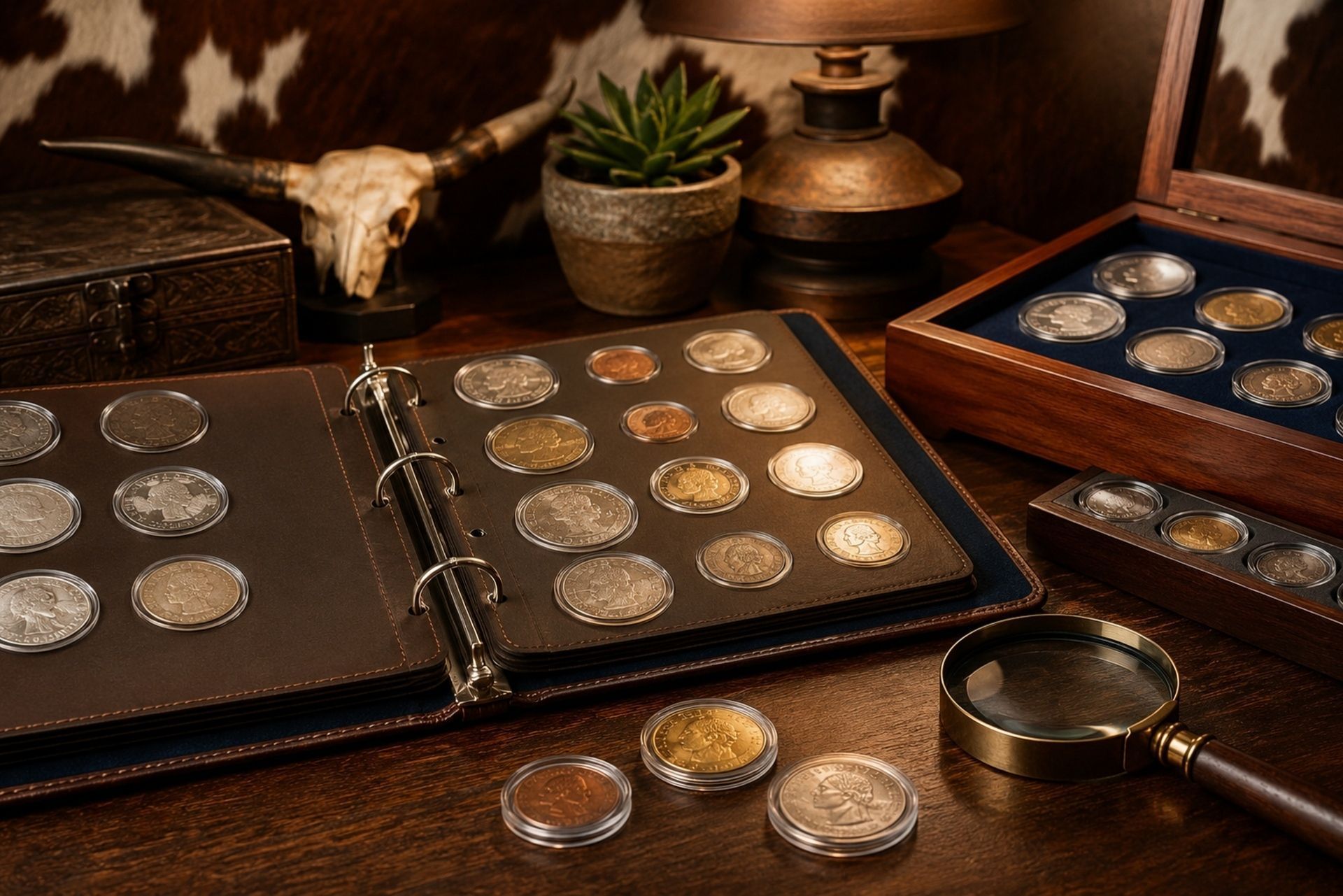
The Valuation and Appraisal Process in the Lone Star State
Your insurance coverage is only as good as your documentation. An insurer won't pay $15,000 for a coin you can't prove was worth $15,000.
Finding Certified Numismatic Appraisers in Texas
Texas has a strong numismatic community, with major dealers and appraisers operating in Houston, Dallas, San Antonio, and Austin. Look for appraisers who hold credentials from the American Numismatic Association or the International Society of Appraisers. A qualified appraiser will evaluate each coin's grade, rarity, provenance, and current market value.
Plan on getting full appraisals every two to three years. The rare coin market fluctuates, and a collection appraised at $80,000 in 2024 might be worth $95,000 or $65,000 by 2026. Outdated appraisals are one of the most common reasons claims get reduced. Appraisal fees typically run $75 to $150 per hour, with most mid-size collections requiring three to six hours of work.
Documenting Your Inventory for Claims Processing
Beyond professional appraisals, you need a personal inventory system. Digital inventory management software designed for collectors lets you log each coin's description, grade, purchase price, current value, and photographs. Take high-resolution photos of both obverse and reverse sides, and store copies in the cloud and on a physical drive kept off-site.
Keep all purchase receipts, auction records, and grading service certificates. If you acquired coins through inheritance, document the provenance chain. Title disputes and contested inheritance claims can complicate insurance payouts, and having clear ownership documentation eliminates that risk entirely. Update your inventory after every acquisition or sale, and share a current copy with your insurance agent annually.
Coins don't stay in safes forever. Shows, grading submissions, and online sales mean your collection is regularly on the move, and that movement creates exposure.
Coverage for Coin Shows and Travel within Texas
Texas hosts dozens of coin shows annually, from the massive Houston Money Show to smaller regional events in Grapevine, Fort Worth, and San Marcos. Transporting $20,000 in coins to a weekend show introduces risks your home-based policy may not cover. Theft from a vehicle, accidental damage during setup, or loss at the venue itself are all real scenarios.
Specialized collector policies typically extend coverage to shows and temporary locations within the United States. Confirm your policy's transit provisions before hitting the road. Some require advance notification if you're transporting items above a certain value. File any loss or theft report within 24 to 72 hours, and always carry a printed copy of your inventory with current photos when traveling with coins.
Shipping Insurance for Grading and Online Sales
Sending coins to PCGS, NGC, or a buyer through the mail is routine for active collectors. Standard USPS or UPS insurance caps at relatively low amounts and involves painful claims processes. Your collector policy should cover items in transit via registered mail or insured carriers.
That said, read the fine print on shipping requirements. Many policies mandate registered mail for items over $1,000 and require signature confirmation. Using a carrier or method not specified in your policy can void coverage entirely. For high-value shipments, consider a specialized shipping service that caters to numismatic dealers and provides its own insurance layer on top of your policy.
Protecting a Texas coin collection requires more than a standard homeowners policy. The sub-limits are too low, the exclusions too broad, and the valuation methods too disconnected from numismatic reality. Whether you choose a scheduled endorsement, blanket policy, or standalone inland marine coverage depends on your collection's size, value distribution, and how actively you buy, sell, and show.
Start by requesting your current homeowners policy's declarations page and checking the sub-limit for money and precious metals. Get a professional appraisal if yours is more than three years old. Then talk to an insurance agent who specializes in collectibles, not just one who sells homeowners policies. The right coin collection insurance coverage protects Texas collectors against the state's harsh weather, humidity, and the everyday risks of being an active numismatist. Don't wait for a loss to find out what your policy actually covers.
Frequently Asked Questions
Does my homeowners insurance cover my coin collection? Technically yes, but only up to a sub-limit of $200 to $300 in most Texas policies. That amount covers face value, not collector value, making it functionally useless for any real collection.
How often should I get my coins appraised for insurance? Every two to three years is the standard recommendation. Market values shift, and an outdated appraisal can result in a significantly reduced claim payout.
Are coins in a bank safe deposit box insured? Not automatically. FDIC insurance doesn't cover safe deposit box contents. You need a separate collector policy or endorsement that specifically lists items stored at a bank.
Does flood insurance cover my coin collection in Texas? The National Flood Insurance Program applies the same restrictive sub-limits as homeowners policies. For real flood protection on coins, you need a standalone collector or inland marine policy.
Will my insurance cover coins I take to a show? Standard homeowners policies usually won't. Specialized collector policies typically include transit and temporary location coverage, but confirm the details and any notification requirements before traveling.
What happens if a coin disappears without proof of theft?
Most homeowners policies exclude mysterious disappearance. Many standalone collector and inland marine policies do cover it, which is a major reason serious collectors choose those options.
About The Author: Aaron Husman
As COO of The Phoenix Insurance, I’m focused on building lasting client relationships and delivering insurance solutions that make protection simple and effective. With years of experience in commercial and personal insurance, I take pride in helping individuals and businesses find coverage that brings confidence and peace of mind.
customer reviews
See What Our Clients Say About Us
Types of Auto Insurance
Insurance For Car Collectors By Car Collectors
Our team specializes in providing tailored insurance coverage for car collectors. Whether you own a rare classic, an exotic beauty, or a powerful muscle car, we understand the unique needs of your collection and work to ensure it’s protected with the care and expertise it deserves.


Contact us for better help and services. Explore all types of car insurance
FREQUENTLY ASKED QUESTIONS
At The Phoenix Insurance, we’re committed to answering your most pressing questions to ensure you feel confident about your coverage. From understanding the benefits of working with an independent agency to the specific insurance options we offer for Texas residents, we’ve got you covered.
What makes The Phoenix Insurance different from other insurance providers?
The Phoenix Insurance is an independent agency, meaning we work with multiple insurance carriers to find the best coverage and rates for your unique needs. Our proactive support and commitment to personalized service set us apart from other providers.
Why should I choose an independent insurance agency in Texas?
Independent agencies like The Phoenix Insurance offer more flexibility and personalized service than large, single-carrier companies. We compare coverage options from top-rated carriers to ensure you get the most value for your money.
Does The Phoenix Insurance provide coverage for real estate investors?
Yes, we specialize in insuring real estate investments, including single-family homes, apartments, commercial buildings, and industrial properties. Our team has extensive experience protecting real estate assets across Texas.
How does The Phoenix Insurance handle claims?
We guide clients through the entire claims process, working directly with the insurance carrier to ensure quick and fair resolutions. Our team is dedicated to providing the support you need when it matters most.
What types of insurance does The Phoenix Insurance offer for Texas residents?
We offer a wide range of personal and business insurance options, including home, auto, umbrella, and recreational vehicle coverage for individuals, as well as liability and property insurance for businesses and real estate investors.
Insurance Knowledge. Stories. Tips.
Our Latest Blogs
Explore expert tips, industry insights, and helpful resources from The Phoenix Insurance to stay informed and make confident decisions about your coverage.



Contact Us