

Owning a Lucid in Texas means you're driving one of the most advanced electric vehicles on the road, but insuring it isn't as simple as calling your current carrier and adding it to an existing policy. Between the high cost of EV-specific components, the state's punishing summer heat, and the scarcity of qualified repair facilities, a standard auto policy often leaves significant gaps. Texas Lucid owners need coverage built around agreed value protection, repair shop choice, and specialized transport and storage provisions. The stakes are real: a fender bender that might cost $3,000 on a conventional sedan can easily run five or six times that on a Lucid Air. And if your insurer defaults to depreciated value or steers you toward the nearest body shop, you could end up with a diminished vehicle and an even more diminished payout. This guide breaks down the four coverage pillars that matter most for Lucid owners in Texas, so you can protect what is likely a six-figure investment without overpaying or under-insuring. Whether you park your Lucid in a Houston garage or drive it daily through the DFW Metroplex, understanding these policy details will save you money and frustration when a claim actually happens.
Protecting Your Investment in the Lone Star State
Texas is the second-largest market for luxury EVs in the country, and Lucid's presence in the state continues to grow. That growth has outpaced the insurance industry's ability to keep up. Most standard auto policies were designed around combustion-engine vehicles with widely available parts and a deep bench of certified mechanics. A Lucid Air Grand Touring, with an MSRP north of $130,000 and a battery pack that costs tens of thousands to replace, doesn't fit that mold.
The catch is that Texas law only requires minimum liability coverage: $30,000 per person for bodily injury, $60,000 per accident, and $25,000 for property damage. That's nowhere near enough to protect the vehicle itself. You'll need comprehensive and collision coverage at a minimum, but even those standard add-ons fall short without the right endorsements. Owners who've gone through the claims process on luxury EVs know that repair estimates can feel staggering compared to what you'd expect on a traditional car.
The right insurance setup for a Texas Lucid owner addresses four specific areas: agreed value, repair shop choice, transport coverage, and storage protection. Each one closes a gap that standard policies leave wide open.
The Importance of Agreed Value vs. Actual Cash Value
TThe single biggest financial risk for Lucid owners is how their insurer determines the vehicle's worth after a total loss. Most standard policies use Actual Cash Value, or ACV, which means the insurer pays what the car is supposedly worth at the moment of the loss, factoring in depreciation. For a mass-market sedan, that might be acceptable. For a Lucid, it's a recipe for a major shortfall.
Why Standard Depreciation Doesn't Work for Lucid Models
Lucid vehicles don't depreciate the way a typical car does. Limited production runs, long wait times for new orders, and rapid technology upgrades create unusual market dynamics. A two-year-old Lucid Air might hold its value better than expected in some trims, while specific configurations could actually appreciate if they're discontinued. Standard depreciation schedules don't account for any of this.
Here's what that means for you: if your Lucid Air is totaled and your insurer applies a generic depreciation curve, you could receive a payout that's $20,000 to $40,000 less than what it would actually cost to replace the vehicle. That gap comes straight out of your pocket. ACV calculations also tend to rely on comparable sales data, and with a relatively small number of Lucid vehicles on the road, those comparisons are often inaccurate or pulled from entirely different markets.
Locking in Your Vehicle's Worth at Policy Inception
Agreed value coverage solves this problem by establishing the vehicle's worth upfront, at the time you purchase the policy. You and your insurer agree on a dollar amount, typically supported by a recent appraisal or purchase documentation, and that's the amount you'll receive in a total loss scenario, minus your deductible.
This approach is standard in the
collector car world, and it's increasingly available for high-value EVs. The premium is usually 10-15% higher than an ACV-based policy, but the peace of mind is worth every cent. One thing to keep in mind: you should update your agreed value every two to three years, or whenever market conditions shift significantly. A
specialized EV insurance provider can help you set the right figure based on current market data rather than generic depreciation tables.
Maintaining Integrity Through Choice of Repair Shop
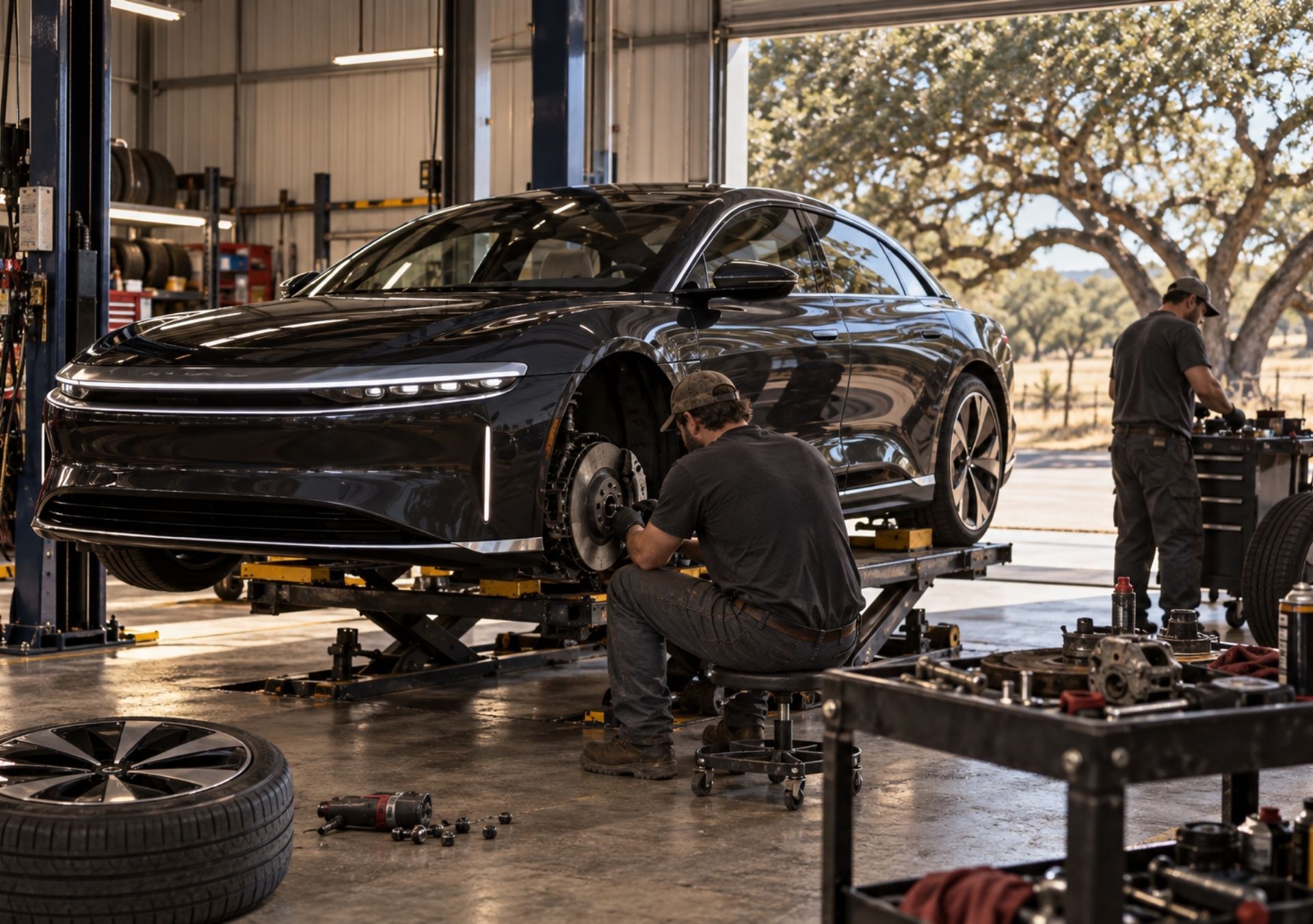
After a collision, your insurer will typically suggest a preferred repair facility. For most cars, that's fine. For a Lucid, it can be a disaster. The wrong shop can compromise everything from the battery pack's thermal management system to the fit and finish of aluminum body panels.
The Necessity of Lucid-Certified Technicians
Lucid vehicles require technicians trained specifically on their platform. The high-voltage battery system alone demands specialized diagnostic equipment and safety protocols that most body shops simply don't have. Sending your Lucid to an uncertified facility risks voided warranties, improper repairs, and potential safety hazards.
Lucid-certified repair shops often charge labor rates as high as $270 per hour for specialized EV work, which is more than double what a standard body shop charges. If your policy doesn't include choice of repair shop provisions, your insurer might push back on those rates or redirect you to a cheaper facility. That's why a policy endorsement guaranteeing your right to choose a Lucid-authorized shop is non-negotiable.
OEM Parts vs. Aftermarket Substitutes
The parts question is just as critical as the labor question. Standard policies often allow insurers to approve aftermarket or salvaged parts to keep claim costs down. For a Lucid, aftermarket parts are scarce and often nonexistent for key components. Even where third-party options exist, they may not meet the tolerances required for proper fit, function, or safety.
Your policy should include an OEM parts endorsement that requires the use of original Lucid components for all repairs. This protects the vehicle's structural integrity, preserves its resale value, and ensures warranty coverage remains intact. Without this endorsement, you could end up fighting your insurer over every line item on a repair estimate.
Specialized Transport and Storage Coverage
Most drivers don't think about what happens to their car between the accident and the repair. For a Lucid, this interim period carries its own risks, especially in Texas.
Flatbed Towing and Battery Safety Protocols
Lucid vehicles should only be towed on a flatbed. Dragging an EV with a conventional tow truck can damage the electric drivetrain, and if the battery pack has been compromised in a collision, improper transport can create a fire risk. Your policy should specify flatbed-only towing and include coverage for the cost, which can run $500 to $1,500 depending on distance in Texas.
Battery safety protocols during transport matter too. A damaged lithium-ion pack needs to be monitored for thermal events during the tow. Some specialized EV towing companies in the Dallas, Houston, and Austin corridors now carry thermal imaging equipment to check battery condition before and during transport. Make sure your policy covers these specialized services rather than defaulting to the cheapest available tow.
Climate-Controlled Storage Requirements for Texas Heat
Texas summers regularly push temperatures above 100°F, and a damaged Lucid sitting in an open lot can suffer additional harm. Extreme heat accelerates battery degradation, warps interior materials, and can cause adhesive failures in body panel repairs that are already underway. If your vehicle is waiting weeks or months for parts, as is common with low-volume EVs, outdoor storage in a Texas summer is a real threat.
Climate-controlled storage coverage ensures your Lucid is kept in a temperature-regulated facility while awaiting repair. This is especially relevant in cities like Houston and San Antonio, where humidity compounds the heat problem. A good policy will cover indoor storage costs for up to 90 days, which aligns with typical repair timelines for complex EV damage claims.
Not all policies are created equal, and the differences between a standard auto policy and a specialized luxury EV policy are dramatic. The table below highlights the key distinctions.
Table: Standard Auto Policy vs. Luxury EV Specialized Coverage
| Coverage Feature | Standard Auto Policy | Luxury EV Specialized Policy |
|---|---|---|
| Valuation Method | Actual Cash Value (depreciated) | Agreed Value (locked at inception) |
| Repair Shop Choice | Insurer-preferred network | Owner selects Lucid-certified facility |
| Parts Authorization | Aftermarket/salvage permitted | OEM Lucid parts required |
| Towing Method | Any available tow service | Flatbed-only with battery protocols |
| Storage During Repair | Open lot, no climate control | Climate-controlled indoor facility |
| Battery Damage Coverage | Limited or excluded | Full pack replacement included |
| Typical Annual Premium | $2,400-$3,600 | $3,800-$5,500 |
| Total Loss Payout Gap | $20,000-$40,000 shortfall possible | Agreed amount minus deductible |
The premium difference between these two approaches typically runs $1,200 to $2,000 per year. On a vehicle worth $80,000 to $150,000, that's a small price to pay for coverage that actually matches the risk.
Common Questions About Texas Lucid Insurance
FAQ: Cost, Claims, and Texas-Specific Regulations
How much does it cost to insure a Lucid Air in Texas? Expect to pay between $3,800 and $5,500 annually for a specialized policy with agreed value and full EV endorsements. Your driving record, ZIP code, and trim level all affect the final number. Dallas and Houston tend to run higher due to traffic density and hail risk.
Does Texas require any special insurance for electric vehicles? Texas doesn't mandate EV-specific coverage beyond standard liability minimums. That said, the state's minimum requirements won't come close to protecting a Lucid. You'll need to add comprehensive, collision, and EV-specific endorsements on your own.
What happens if my battery is damaged in a minor accident? Even a low-speed collision can compromise the battery enclosure. If diagnostic testing reveals internal cell damage, a full pack replacement can cost $25,000 or more. Make sure your policy explicitly covers battery pack replacement, not just repair.
Can I use any body shop for repairs? Only if your policy includes a choice of repair shop endorsement. Without it, your insurer can direct you to their preferred facility, which may not be Lucid-certified. Always confirm this endorsement is included before you sign.
How long do Lucid repairs typically take in Texas? Parts availability is the biggest variable. Simple repairs might take two to four weeks, but more complex claims involving structural or battery work can stretch to three months or longer. Climate-controlled storage coverage becomes critical during extended repair timelines.
Does hail damage fall under comprehensive coverage? Yes, but hail is a major concern in North Texas, and aluminum body panels on a Lucid are more expensive to repair than steel. Make sure your comprehensive coverage limits are high enough to cover a full-panel replacement if needed.
Making the Right Choice for Your Lucid
Your Lucid represents a significant financial commitment, and the insurance protecting it should match that investment. A standard Texas auto policy leaves too many gaps: depreciation-based payouts, uncertified repair shops, generic towing, and outdoor storage in triple-digit heat. Each of those gaps can cost you thousands when a claim hits.
The right policy combines agreed value protection, choice of a Lucid-certified repair facility, OEM parts guarantees, flatbed transport with battery safety protocols, and climate-controlled storage. Yes, the premium runs higher than a basic policy. But the alternative, absorbing a $30,000 payout shortfall or watching your Lucid sit in a sun-baked lot for weeks, is far more expensive.
Start by getting quotes from insurers who specialize in high-value EVs. Bring your purchase documentation, request an agreed value endorsement, and confirm every coverage detail in writing before you commit. Your Lucid deserves more than a one-size-fits-all policy, and so do you.
About The Author: Aaron Husman
As COO of The Phoenix Insurance, I’m focused on building lasting client relationships and delivering insurance solutions that make protection simple and effective. With years of experience in commercial and personal insurance, I take pride in helping individuals and businesses find coverage that brings confidence and peace of mind.
customer reviews
See What Our Clients Say About Us
Types of Auto Insurance
Insurance For Car Collectors By Car Collectors
Our team specializes in providing tailored insurance coverage for car collectors. Whether you own a rare classic, an exotic beauty, or a powerful muscle car, we understand the unique needs of your collection and work to ensure it’s protected with the care and expertise it deserves.


Contact us for better help and services. Explore all types of car insurance
FREQUENTLY ASKED QUESTIONS
At The Phoenix Insurance, we’re committed to answering your most pressing questions to ensure you feel confident about your coverage. From understanding the benefits of working with an independent agency to the specific insurance options we offer for Texas residents, we’ve got you covered.
What makes The Phoenix Insurance different from other insurance providers?
The Phoenix Insurance is an independent agency, meaning we work with multiple insurance carriers to find the best coverage and rates for your unique needs. Our proactive support and commitment to personalized service set us apart from other providers.
Why should I choose an independent insurance agency in Texas?
Independent agencies like The Phoenix Insurance offer more flexibility and personalized service than large, single-carrier companies. We compare coverage options from top-rated carriers to ensure you get the most value for your money.
Does The Phoenix Insurance provide coverage for real estate investors?
Yes, we specialize in insuring real estate investments, including single-family homes, apartments, commercial buildings, and industrial properties. Our team has extensive experience protecting real estate assets across Texas.
How does The Phoenix Insurance handle claims?
We guide clients through the entire claims process, working directly with the insurance carrier to ensure quick and fair resolutions. Our team is dedicated to providing the support you need when it matters most.
What types of insurance does The Phoenix Insurance offer for Texas residents?
We offer a wide range of personal and business insurance options, including home, auto, umbrella, and recreational vehicle coverage for individuals, as well as liability and property insurance for businesses and real estate investors.
Insurance Knowledge. Stories. Tips.
Our Latest Blogs
Explore expert tips, industry insights, and helpful resources from The Phoenix Insurance to stay informed and make confident decisions about your coverage.


Contact Us