

Owning a Bollinger
electric truck in Texas puts you in a unique category. These vehicles aren't mass-market commuters. They're purpose-built,
high-value machines with aluminum chassis, all-electric drivetrains, and price tags that demand serious insurance consideration. A standard auto policy treats your B1, B2, or B4 like any other truck on the road, and that disconnect can cost you tens of thousands of dollars after a total loss or major repair. The right insurance strategy for a Bollinger in Texas hinges on four pillars: agreed value protection, the freedom to choose your repair facility, covered transport, and storage safeguards. Getting each of these right means your investment stays protected whether your truck is parked in a climate-controlled garage in Houston,
hauling equipment near Midland, or being trailered to an EV expo in Dallas. This guide breaks down what Texas Bollinger owners actually need from their policies, where
standard coverage falls short, and how to structure protection that matches the real-world value and use of these trucks.
Protecting Your Bollinger Motors Investment in Texas
The Bollinger B4 carries a high MSRP of $158,758. That's not a rounding error on your insurance declaration page. Yet most standard Texas auto policies would pay out based on whatever a depreciation algorithm says your truck is worth at the time of a claim, not what you paid or what it would cost to replace. This gap between market perception and actual replacement cost is where Bollinger owners get burned.
Texas doesn't require any specific type of valuation method on your policy. The state mandates liability minimums of 30/60/25, but how your own vehicle gets valued after a loss is entirely between you and your insurer. That freedom cuts both ways. You can lock in strong protection, or you can unknowingly accept a policy that undervalues your truck by $40,000 or more.
The specialized nature of Bollinger trucks, from their hydro-formed aluminum frames to their Class 3 and Class 4
commercial ratings, means they don't fit neatly into the databases that standard insurers use. Building a policy around agreed value, repair choice, transport, and storage coverage isn't optional for these vehicles. It's the baseline.
Agreed Value Coverage vs. Actual Cash Value
The single most important coverage decision you'll make for your Bollinger is how the policy determines your payout after a total loss. Two methods dominate the market, and they produce wildly different results.
Actual cash value (ACV) policies subtract depreciation from your truck's original value. The insurer's algorithm factors in age, mileage, condition, and comparable sales. For a mainstream pickup with thousands of comps on the used market, ACV can be reasonably fair. For a low-volume electric truck like the Bollinger B4, there simply aren't enough comparable sales to generate an accurate number. The result is often a payout that leaves you $30,000 to $50,000 short of what you'd need to replace the vehicle.
Agreed value policies eliminate that guesswork. You and your insurer settle on a specific dollar amount when the policy is written. If the truck is totaled, that's what you receive, minus any applicable deductible. No depreciation formulas, no arguments over comp sales.
Why Depreciation Doesn't Apply to Your Agreed Value Policy
Standard depreciation models assume a vehicle loses value predictably over time. Mass-produced trucks do follow that curve. Bollinger trucks don't. Limited production numbers, specialized components, and strong demand among EV enthusiasts mean these vehicles can hold or even appreciate in value during their first several years.
An agreed value policy locks in a specific payout amount that reflects the truck's true replacement cost. If your B4 is insured at $155,000 and gets totaled in a hailstorm outside San Antonio, you receive $155,000. The insurer can't apply a depreciation schedule to reduce that figure. This matters because Texas sees some of the most destructive hail events in the country, and total losses from storm damage are common.
Establishing the Worth of Your B1 or B2 Electric Vehicle
Getting your agreed value right requires documentation. Start with the original purchase price, including any factory options or accessories. Then get a professional appraisal from someone who understands the EV market, not just a general auto appraiser. For Bollinger trucks, this means finding an appraiser familiar with low-volume commercial EVs.
Keep records of any upgrades: auxiliary battery packs, aftermarket bed systems, or specialized tooling mounts. These add to replacement cost and should be reflected in your agreed value. Plan to update your appraisal every two to three years, or whenever you make significant modifications. Your insurer will want current documentation if you need to adjust your coverage upward.
Repair Choice and Specialized EV Maintenance
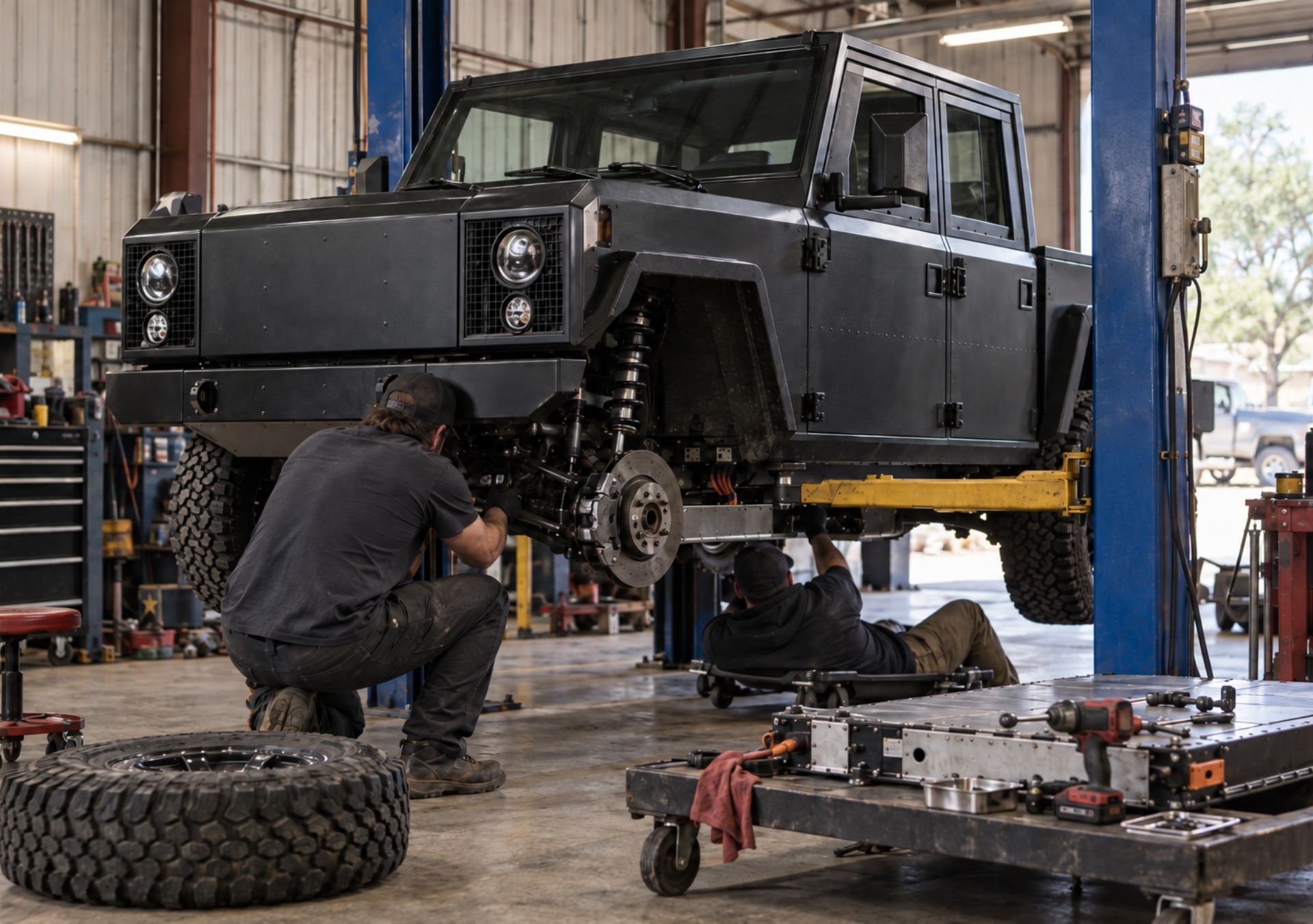
A Bollinger truck isn't something you drop off at the nearest body shop. The aluminum unibody construction, high-voltage battery systems, and proprietary drivetrain components require technicians with specific training and equipment. Your insurance policy's repair provisions matter here just as much as the valuation method.
Many standard policies include "preferred shop" language that steers you toward the insurer's network of approved repair facilities. These shops may be perfectly competent with conventional trucks but lack the tooling or certification to work on a Bollinger's electrical architecture. A botched high-voltage repair isn't just expensive to fix. It's dangerous.
The Importance of Choosing Your Own Texas Repair Shop
Texas law gives you the right to choose your own repair facility after an accident. Your insurer can recommend a shop, but they can't force you to use a specific facility or penalize you for going elsewhere. This is a critical protection for Bollinger owners.
That said, not every policy makes exercising this right easy. Some insurers will only guarantee repairs performed at their preferred shops, leaving you without a warranty if you go to a specialist. Look for a policy that explicitly guarantees repair quality regardless of which licensed shop performs the work. In Texas, Bollinger-qualified repair facilities are concentrated in major metros like Dallas-Fort Worth, Houston, and Austin. If you're in a rural area, you may need to transport your truck to a qualified shop, which ties directly into your transport coverage.
OEM Parts Guarantees for Bollinger Chassis
Aftermarket parts don't exist for most Bollinger components. The aluminum chassis panels, battery enclosures, and drivetrain modules are all proprietary. If your policy allows the insurer to substitute "like kind and quality" parts, you could end up with generic components that don't meet Bollinger's engineering specifications.
Insist on a policy endorsement that guarantees OEM parts for structural and drivetrain repairs. This is especially important for the battery housing and thermal management system, where fit and material quality directly affect safety. The cost difference between an OEM-guaranteed policy and a standard one is typically modest, often $100 to $200 per year, but the protection gap is enormous.
Specialized Transport and Storage Protection
Your Bollinger doesn't just need coverage while it's on the road. Transport between locations and time spent in storage create their own risk profiles that standard policies often ignore or exclude.
Flatbed Towing and Transport Coverage Limits
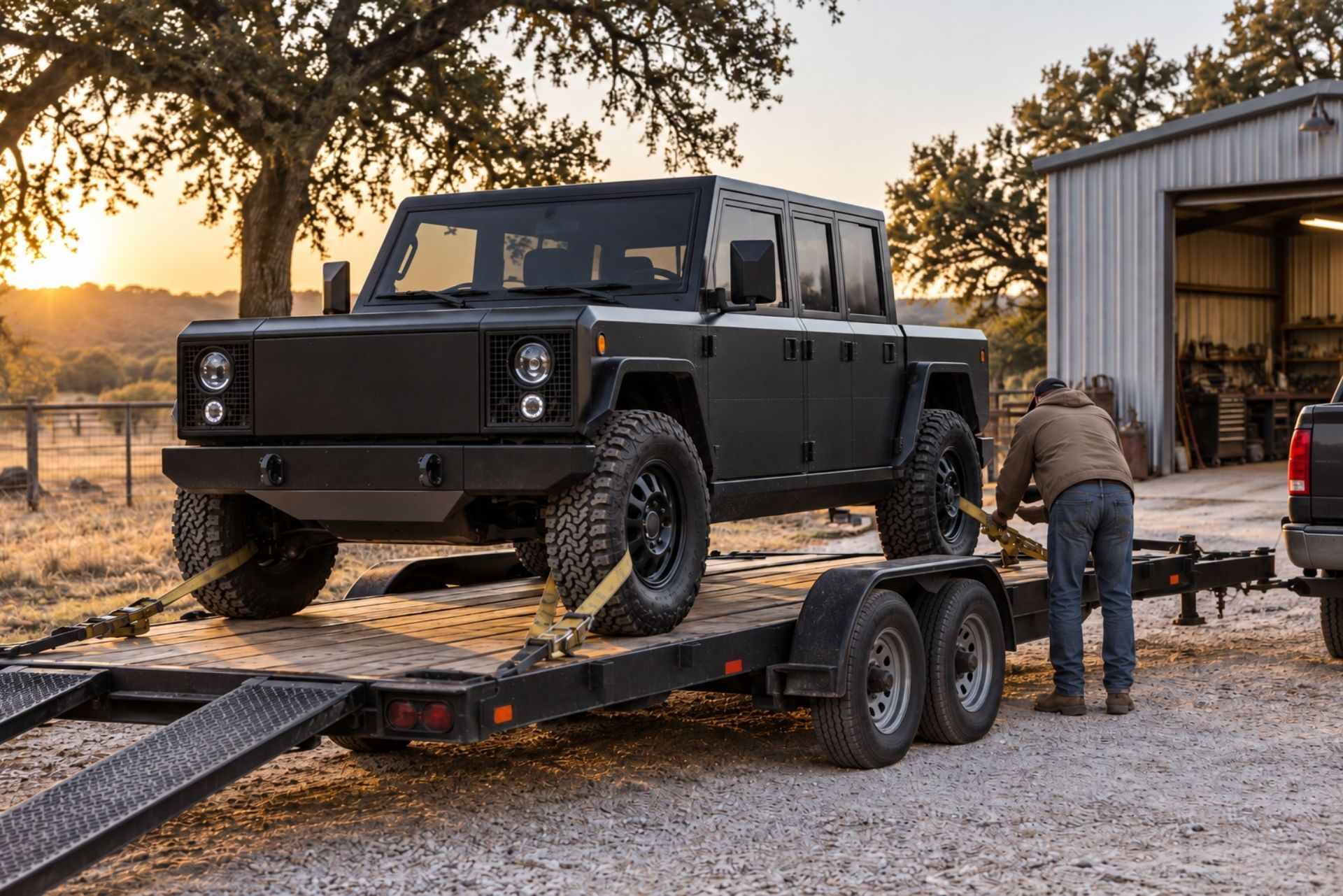
Bollinger trucks should only be transported on flatbed carriers. The electric drivetrain can be damaged by flat-towing, and the vehicle's weight (the B4 tips the scales at over 8,000 pounds) exceeds the capacity of many standard tow trucks. Your policy needs to cover flatbed transport specifically, with limits high enough to handle long-distance moves.
If you're trailering your Bollinger to shows, expos, or job sites, specialized electric truck insurance should extend protection to cover damage during loading, transit, and unloading. Standard policies typically cover towing only after a breakdown or accident, not planned transport. Look for a transit endorsement that covers your truck door-to-door, including while it's secured on a trailer.
Typical flatbed tow rates in Texas run $4 to $7 per mile for heavy vehicles. A 200-mile tow from a rural breakdown to a qualified repair shop in Dallas could cost $1,400 or more. Make sure your towing limit reflects these real-world costs, not the $100 or $200 cap found on many basic policies.
Climate-Controlled Storage Endorsements
Texas heat is brutal on EV batteries. Sustained temperatures above 100°F accelerate battery degradation, and the state regularly hits those numbers from June through September. If you store your Bollinger in a climate-controlled facility during part of the year, or even overnight in a temperature-regulated garage, your policy should reflect that arrangement.
A storage endorsement typically reduces your premium during periods when the vehicle isn't being driven, while maintaining comprehensive coverage for fire, theft, vandalism, and weather damage. Some policies require you to notify the insurer when the vehicle enters or leaves storage. Others offer a "laid-up" provision that automatically adjusts coverage.
Keep your storage facility's temperature between 50°F and 80°F for optimal battery health. Document the facility's HVAC system and any backup power provisions. If the climate control fails during a Texas summer and your battery pack suffers thermal damage, you'll want clear policy language covering that scenario.
Comparing Standard vs. Specialized Bollinger Coverage
The differences between a standard Texas auto policy and a specialized Bollinger policy are significant. Here's how they stack up across the coverage areas that matter most:
| Coverage Area | Standard Auto Policy | Specialized Bollinger Policy |
|---|---|---|
| Valuation Method | Actual cash value (depreciation applied) | Agreed value (fixed payout) |
| Repair Shop Choice | Preferred network encouraged | Any qualified facility, guaranteed |
| Parts | "Like kind and quality" substitutions | OEM parts guaranteed |
| Towing Limit | $100-$200 per incident | $1,500-$3,000+ flatbed specific |
| Transit Coverage | Breakdown/accident towing only | Door-to-door transport protection |
| Storage | No adjustment or endorsement | Laid-up coverage with reduced premium |
| Battery Damage | Often excluded or limited | Thermal and electrical damage covered |
The premium difference between these two approaches typically runs 15% to 30% higher for the specialized policy. On a $158,000 vehicle, that's a small price for coverage that actually matches your exposure.
Common Questions About Texas Bollinger Insurance
Does Texas require agreed value coverage on my Bollinger? No. Texas only mandates minimum liability coverage. Agreed value is an optional but strongly recommended upgrade for any high-value vehicle, especially one with limited comparable sales data.
Can my insurer force me to use their preferred repair shop? They cannot. Texas law protects your right to choose any licensed repair facility. That said, confirm your policy guarantees repairs regardless of which shop you select.
What happens if my Bollinger's battery is damaged in a flood? Standard comprehensive coverage may apply, but many policies exclude or limit battery-specific damage. Look for explicit coverage for high-voltage battery systems, including flood, thermal events, and electrical surge.
How often should I update my agreed value? Every two to three years, or after any significant modification. If Bollinger production numbers stay low and demand stays high, your truck's replacement cost could increase over time.
Is my Bollinger covered while being trailered to an event? Only if your policy includes a transit endorsement. Standard auto policies typically don't cover planned transport on a trailer.
Do I get a discount for storing my truck in a climate-controlled facility? Many specialized insurers offer reduced premiums during storage periods. Ask about laid-up coverage or storage endorsements when shopping for your policy.
Making the Right Choice for Your Electric Truck
Your Bollinger represents a significant financial commitment, and protecting it requires more than a standard Texas auto policy can deliver. The core of a proper insurance strategy starts with agreed value coverage that reflects the true replacement cost of your vehicle. From there, repair choice protections ensure your truck gets serviced by technicians who understand its unique construction, while transport and storage endorsements fill the gaps that standard policies leave wide open.
Before you bind a policy, get a current professional appraisal, document every modification, and read the fine print on parts guarantees and towing limits. Ask your agent specifically about battery damage exclusions, because that's where many Bollinger owners discover coverage gaps after it's too late. The right policy won't just cover your truck. It'll protect the full value of what you've invested in owning one of the most distinctive electric vehicles on the road.
About The Author: Aaron Husman
As COO of The Phoenix Insurance, I’m focused on building lasting client relationships and delivering insurance solutions that make protection simple and effective. With years of experience in commercial and personal insurance, I take pride in helping individuals and businesses find coverage that brings confidence and peace of mind.
customer reviews
See What Our Clients Say About Us
Types of Auto Insurance
Insurance For Car Collectors By Car Collectors
Our team specializes in providing tailored insurance coverage for car collectors. Whether you own a rare classic, an exotic beauty, or a powerful muscle car, we understand the unique needs of your collection and work to ensure it’s protected with the care and expertise it deserves.


Contact us for better help and services. Explore all types of car insurance
FREQUENTLY ASKED QUESTIONS
At The Phoenix Insurance, we’re committed to answering your most pressing questions to ensure you feel confident about your coverage. From understanding the benefits of working with an independent agency to the specific insurance options we offer for Texas residents, we’ve got you covered.
What makes The Phoenix Insurance different from other insurance providers?
The Phoenix Insurance is an independent agency, meaning we work with multiple insurance carriers to find the best coverage and rates for your unique needs. Our proactive support and commitment to personalized service set us apart from other providers.
Why should I choose an independent insurance agency in Texas?
Independent agencies like The Phoenix Insurance offer more flexibility and personalized service than large, single-carrier companies. We compare coverage options from top-rated carriers to ensure you get the most value for your money.
Does The Phoenix Insurance provide coverage for real estate investors?
Yes, we specialize in insuring real estate investments, including single-family homes, apartments, commercial buildings, and industrial properties. Our team has extensive experience protecting real estate assets across Texas.
How does The Phoenix Insurance handle claims?
We guide clients through the entire claims process, working directly with the insurance carrier to ensure quick and fair resolutions. Our team is dedicated to providing the support you need when it matters most.
What types of insurance does The Phoenix Insurance offer for Texas residents?
We offer a wide range of personal and business insurance options, including home, auto, umbrella, and recreational vehicle coverage for individuals, as well as liability and property insurance for businesses and real estate investors.
Insurance Knowledge. Stories. Tips.
Our Latest Blogs
Explore expert tips, industry insights, and helpful resources from The Phoenix Insurance to stay informed and make confident decisions about your coverage.


Contact Us