
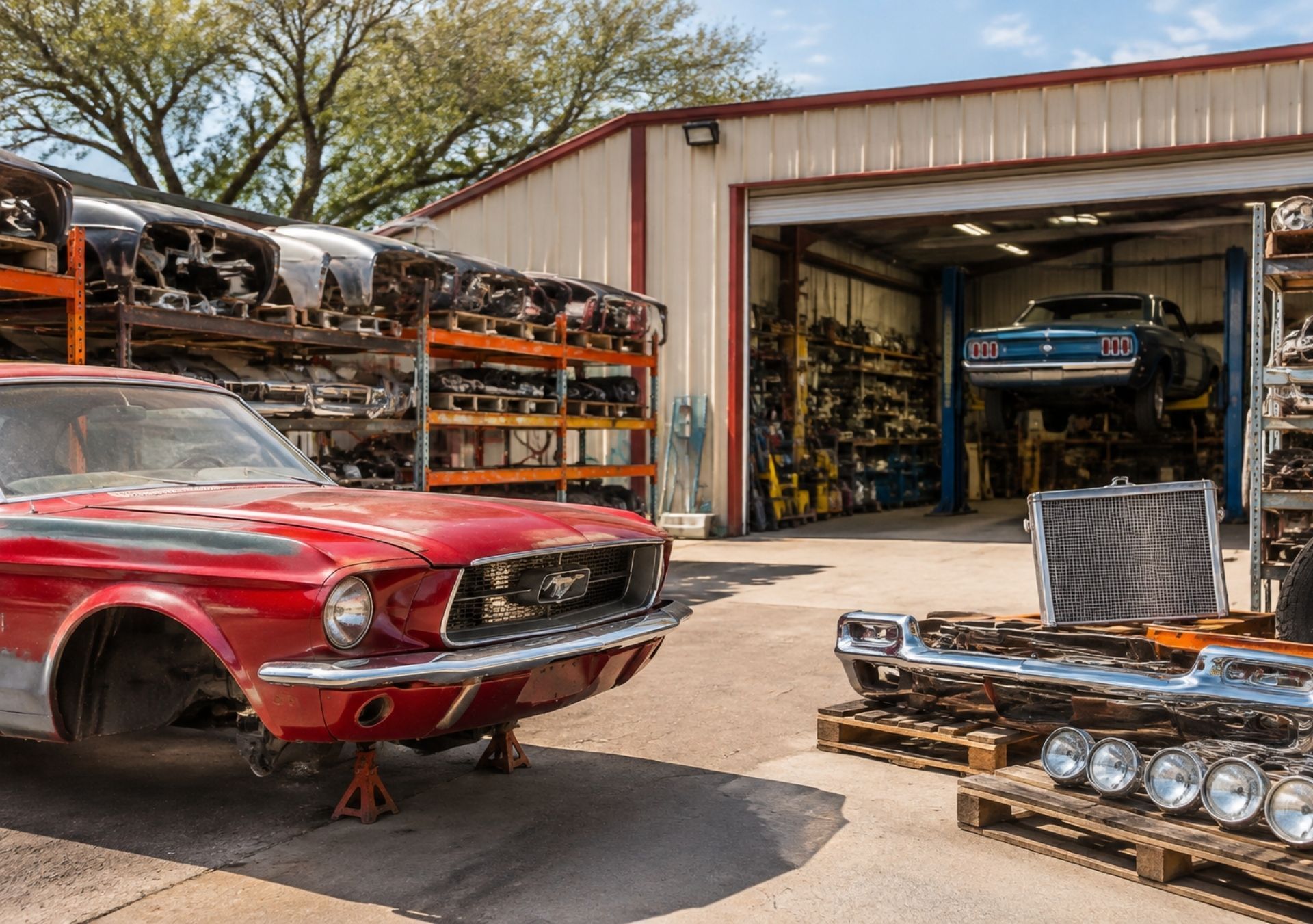
A single hail storm can shred a warehouse roof in Lubbock, soak $80,000 worth of NOS trim and reproduction sheet metal, and close your doors for six weeks while you wait on a replacement roof and a new shipment of Mopar quarter panels. Classic car parts dealers in Texas face a strange mix of risks. You're part retailer, part warehouse, part technical advisor, and sometimes part repair shop with a customer's '67 Chevelle sitting in your bay.
That combination is why standard small business policies so often fall short for this trade. Insurance for a Texas classic car parts dealer has to cover liability, property, customer autos, and business interruption, and each piece has its own traps. The market is also getting bigger. The classic car restoration and restomod sector is valued at $7.9 billion in 2026, with projected growth of 6.2% a year through 2036. More customers means more sales, more inventory on your shelves, and more exposure when something goes wrong.
What follows is a practical breakdown of how to build coverage that actually pays when you file a claim.
Risk Management for Texas Classic Car Part Dealers
Good insurance starts before you ever call an agent. Underwriters price your policy based on how likely you are to file a claim, and shops with documented loss prevention almost always get better terms. Just as important, the steps below make your claims easier to prove when disaster hits.
Start with your inventory records. Use digital inventory management software that tracks part numbers, condition, acquisition cost, and current market value. Photograph rare items individually, especially NOS parts still in original packaging, date-coded components, and anything with documented provenance. A claims adjuster won't take your word that a box held a factory-original Hemi intake. They'll want proof.
Physical protection matters just as much:
- Climate control: Humidity on the Gulf Coast destroys chrome, rubber, and paper documentation. Keep HVAC running steadily and consider a backup generator so a power outage doesn't turn your stock into rust.
- Storage positioning: Keep high-value parts off the floor and away from exterior walls and roof drains. Flash flooding in Houston and San Antonio regularly puts several inches of water inside commercial buildings.
- Security: Monitored alarms, cameras covering loading doors, and locked cages for rare components reduce theft claims and often earn premium credits.
- Evacuation plan: Know which items leave the building first if a hurricane is tracking toward Corpus Christi. Write it down and assign people.
Get rare inventory professionally appraised every two to three years. Values for vintage parts swing with collector demand, and an outdated appraisal can leave you badly underinsured.
Core Liability Coverage for Specialized Inventory
Liability claims against parts dealers rarely start with a dramatic event. They usually begin with a customer letter, followed by a lawyer's letter, after a part fails or someone gets hurt. Your liability coverage is what pays for your defense and any settlement.
General Liability vs. Product Liability
General liability (GL) covers bodily injury and property damage tied to your premises and operations. Think of a customer tripping over a transmission case in your aisle, or your delivery driver denting a customer's garage door while dropping off a fender.
Product liability, usually included in a GL policy as "products-completed operations" coverage, protects you when something you sold causes harm. This is the bigger exposure for parts dealers. If a reproduction brake master cylinder you sold fails and causes a crash, you can be named in the lawsuit even though you didn't manufacture it.
| Coverage | What It Covers | Example Claim |
|---|---|---|
| General Liability | Injuries and damage at your shop or from your operations | Customer slips on spilled oil near your counter |
| Product Liability | Harm caused by parts you sold | Aftermarket steering box fails, causing a wreck |
| Professional Liability | Financial loss from your advice or expertise | You recommend the wrong rebuild kit and the engine seizes |
One thing to keep in mind: check whether your products-completed operations limit is shared with your general aggregate. If one big product claim eats the whole aggregate, you have nothing left for a slip-and-fall later that year. There's also some useful Texas case law here. The Texas Business Court has reaffirmed that the economic-loss rule bars negligent misrepresentation claims against "contractual strangers," which can limit how far supply chain disputes reach you. That's a legal defense, not a substitute for coverage.
Professional Liability for Restoration Advice
Many parts dealers act as informal consultants. Customers call asking which carburetor fits their numbers-matching GTO or whether a restomod suspension kit works with their frame. When your recommendation turns out wrong and the customer loses money, that's a professional liability claim, and most GL policies exclude it.
Picture a customer who spends $14,000 on a complete drivetrain package you specified, only to find it doesn't clear the firewall on their 1970 Cuda. No one got hurt, so GL won't respond. Professional liability (errors and omissions) would cover the defense and the financial loss.
Protecting High-Value Inventory and Real Property
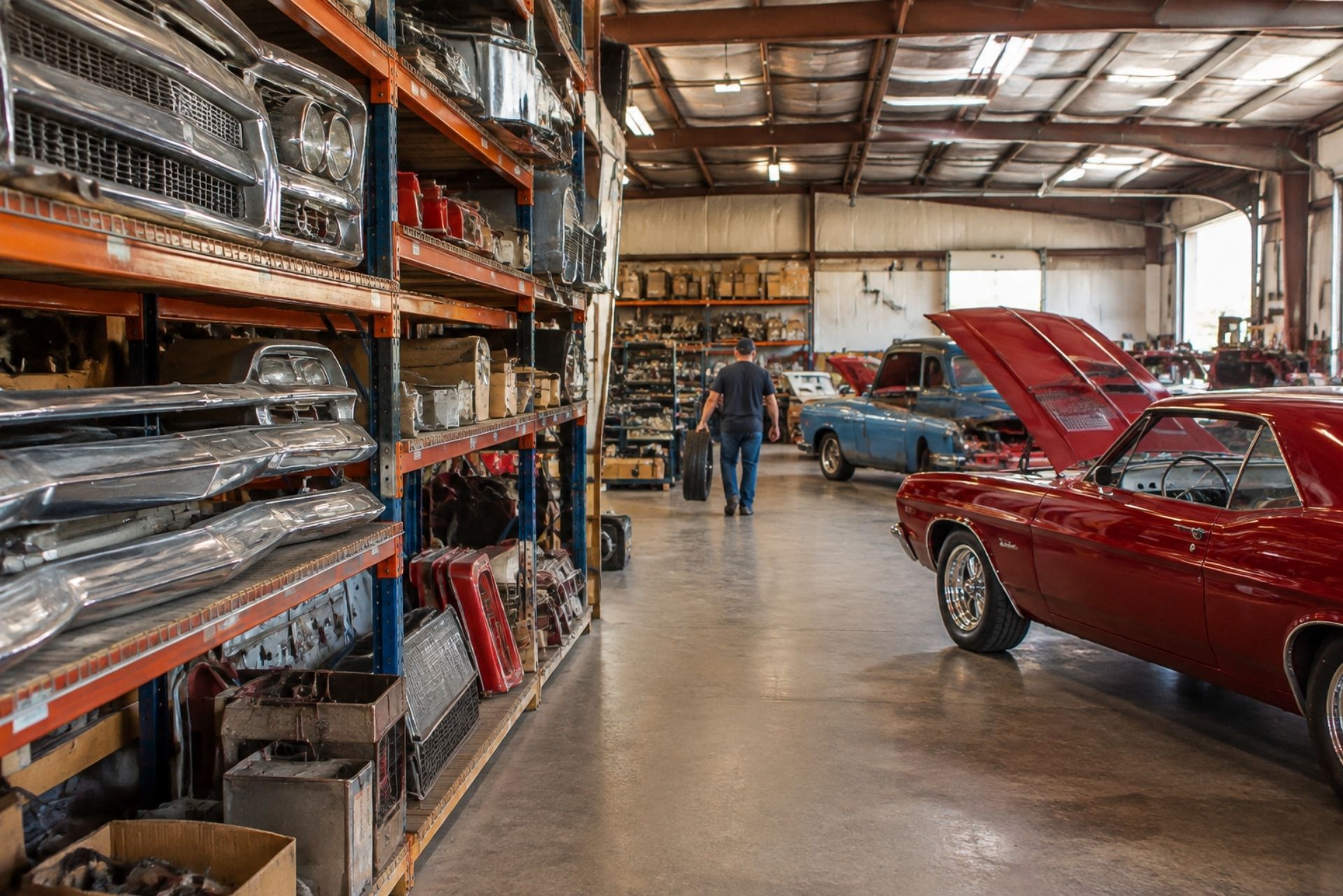
Commercial property insurance covers your building if you own it, plus your inventory, shelving, tools, computers, and office equipment. For a classic parts dealer, inventory is usually the largest number on the schedule, and also the hardest to value.
Actual Cash Value vs. Replacement Cost
These two terms decide how much money you actually receive after a loss, and mixing them up is one of the most expensive mistakes I see.
Actual cash value (ACV) pays what the item was worth at the time of the loss, which means replacement cost minus depreciation. Replacement cost pays what it costs to buy the item new today, without subtracting for age or wear. On a building or shelving system, replacement cost is almost always the better choice.
Classic parts complicate this. A 1969 Camaro SS hood in original condition can't be "replaced new" because nobody makes it anymore. For rare or appreciating stock, ask about agreed value or stated value scheduling, where you and the insurer agree on the item's worth up front based on an appraisal. That's not a minor detail. Without it, an adjuster may value a rare part at the price of a reproduction.
Also watch for "mysterious disappearance" exclusions. That term refers to property that vanishes with no evidence of how, such as inventory you can't find during a count. Many policies exclude it unless you can show signs of theft.
Inland Marine Insurance for Parts in Transit
Your property policy generally covers items at your listed location. Once parts leave the building, coverage often drops off or shrinks to a tiny sublimit. Inland marine insurance fills that gap.
This matters if you haul inventory to swap meets like the Pate Swap Meet near Fort Worth, display parts at car shows, ship engines out for machining, or send items for appraisal. A trailer full of chrome bumpers stolen from a hotel parking lot in Houston during a show weekend won't be covered by a standard property policy. Inland marine (sometimes called a floater) follows the property wherever it goes, including while it's at a vendor's shop for restoration.
Garagekeepers Coverage for Customer Vehicles
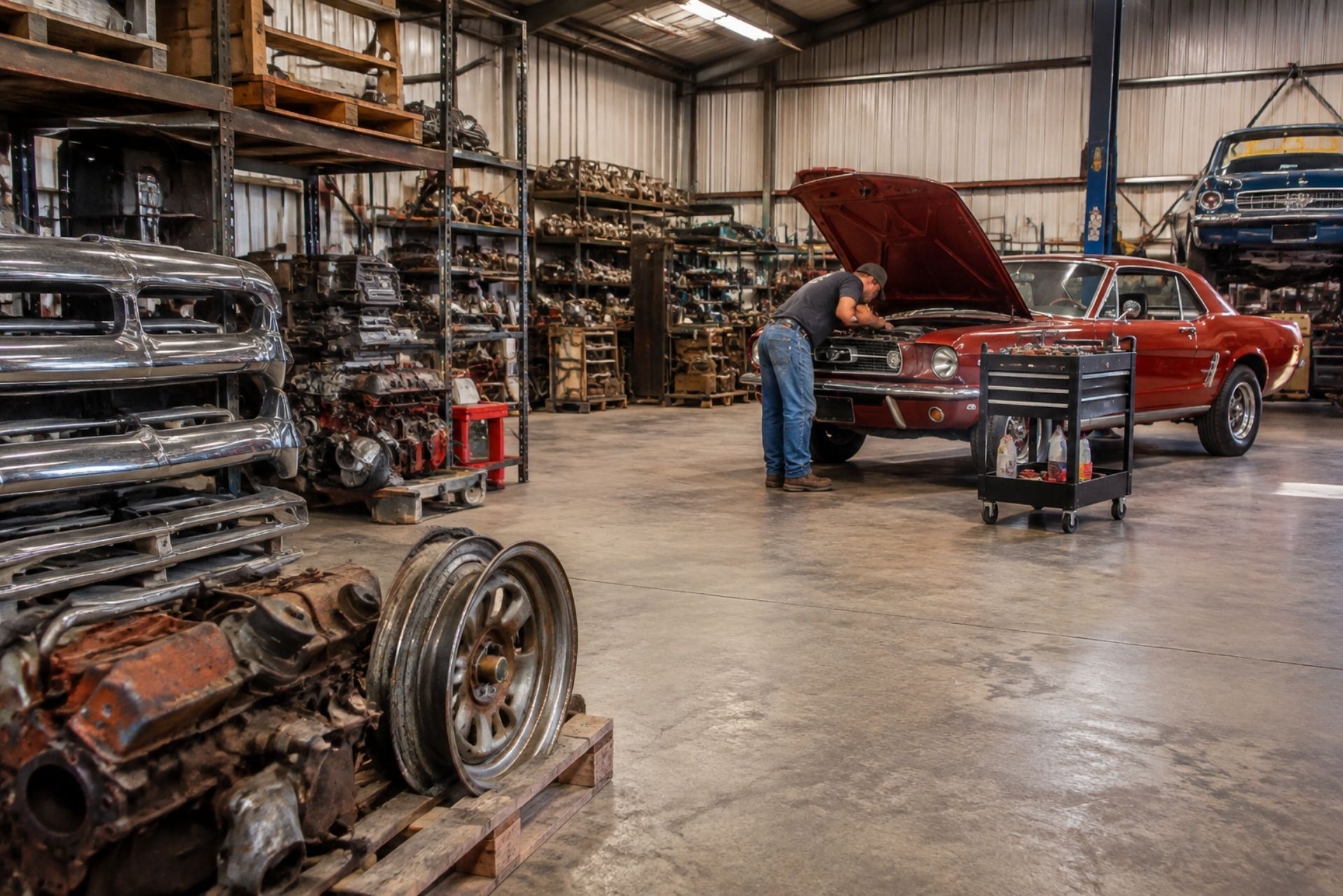
If customers ever leave their cars with you, even briefly, you need garagekeepers coverage. Dealers who install parts, test fit components, or store project cars face this exposure constantly, and many don't realize their GL policy specifically excludes damage to property in their care, custody, or control.
Here's the scenario. A customer drops off a 1965 Shelby GT350 for a new exhaust installation. Overnight, an electrical fire starts in your shop and the car burns. Your property policy covers your building and stock, not the customer's car. Your GL excludes it. Without garagekeepers, you're personally on the hook for a vehicle that could be worth several hundred thousand dollars.
Garagekeepers comes in three main forms:
- Legal liability: Pays only if you were negligent. If a tornado hits the shop, you may owe nothing, but the customer gets nothing either, which can wreck your reputation.
- Direct primary: Pays for damage regardless of fault. The best option for shops handling collector vehicles.
- Direct excess: Pays regardless of fault, but only after the customer's own auto insurance responds.
Set your per-vehicle and per-location limits based on the most valuable car you might ever hold, not the average one. If you store three high-end classics at once, a single fire could exceed a low location limit quickly. Also confirm whether the policy covers cars while you're test-driving them, since that often falls under garage liability instead.
Managing Business Interruption and Income Loss
Business interruption insurance replaces lost income and pays continuing expenses, like rent, payroll, and loan payments, when a covered property loss forces you to close or slow down. For parts dealers, the waiting period after a loss can stretch far longer than owners expect.
The policy pays during what's called the "period of restoration," meaning the time reasonably needed to repair the building and get back to business. Supply chains make this harder to predict. Major manufacturers such as General Motors have set up $4.5 billion in parts stockpiles to buffer global instability, a sign that sourcing delays are real and that the period of restoration for claims is stretching out. If your racking, lift equipment, or replacement stock takes months to arrive, a policy capped at 90 days won't carry you.
The Texas power grid adds another wrinkle. Standard business interruption only kicks in when your own property suffers physical damage. A Utility Services Interruption endorsement extends coverage to income lost from off-premises power or water outages, which has become more important given the state's aging electrical infrastructure. A multi-day outage during a winter freeze could kill your online order fulfillment without a single thing breaking in your building.
Ask about extended period of indemnity too. It pays for lost income for a set time after you reopen, while customers drift back.
Comparing Policy Tiers and Coverage Limits
Most dealers start with a Business Owner's Policy (BOP), which bundles general liability and property at a discount. A BOP is fine for a small storefront, but it often comes with low limits and exclusions that don't fit specialty inventory. As your business grows, you'll likely move to a custom commercial package.
| Feature | Basic BOP | Enhanced Package | Specialty Program |
|---|---|---|---|
| GL limits | $1M / $2M | $1M / $2M plus umbrella | $1M / $2M plus $5M umbrella |
| Inventory valuation | ACV | Replacement cost | Agreed value on rare stock |
| Garagekeepers | Not included | Legal liability | Direct primary |
| Transit coverage | Small sublimit | Inland marine floater | Full inland marine |
| Business interruption | Limited time | 12 months | 12+ months with utility endorsement |
| Professional liability | Excluded | Optional | Included |
These tiers are illustrative, so your actual options depend on the carrier and your loss history. Commercial umbrella coverage is worth pricing once you handle customer vehicles or sell safety-critical parts like brakes and steering components. A single serious injury verdict can blow past a $1 million limit.
Don'ts when choosing limits:
- Don't set inventory limits based on what you paid years ago
- Don't assume your landlord's policy covers your improvements
- Don't skip garagekeepers because "customers rarely leave cars"
- Don't accept a BOP without reading the exclusions page
- Don't forget to update limits after you buy a large collection
Texas-Specific Insurance Requirements and Considerations
Texas has its own rules and risks that shape how you should buy coverage. Some are regulatory, and some come straight from the weather.
If you sell vehicles as a licensed dealer, Texas requires a $50,000 surety bond for a two-year term. That bond protects the state and consumers against unlawful or unethical acts. It's not liability insurance and won't pay a claim on your behalf. If the surety pays out, you have to reimburse it.
Disputes over coverage are also handled differently now. New local rules for the Texas Business Court took effect October 1, 2026, designed to streamline high-stakes insurance coverage disputes over $5 million. Most dealer claims won't hit that number, but larger operations should know the forum exists.
Texas Windstorm and Hail Provisions
Many commercial policies in Texas carry separate wind and hail deductibles, often written as a percentage of the building's insured value rather than a flat dollar amount. On a $1 million building with a 2% wind deductible, you'd pay the first $20,000 yourself. That's not a typo, and it surprises plenty of owners after their first hail claim.
Along the coast, some policies exclude windstorm entirely, requiring separate coverage through the Texas Windstorm Insurance Association. In the Panhandle and the Dallas-Fort Worth area, hail is the bigger concern. Check your roof's age, since some carriers pay roofs on an ACV basis once they pass a certain age.
Workers' Compensation in the Lone Star State
Texas is the only state where most private employers can choose not to carry workers' comp. Opting out, called being a "nonsubscriber," might look like a savings. The catch is that nonsubscribers lose key legal defenses, and an injured employee can sue you directly for negligence.
For a parts business where staff lift cylinder heads, climb warehouse racking, and work around lifts, that's a serious exposure. Most dealers with employees are better off carrying workers' comp or a well-structured occupational injury plan.
Common Questions About Classic Car Parts Insurance
Does my general liability policy cover customer cars I'm working on? No. GL typically excludes property in your care, custody, or control, so you need garagekeepers coverage for customer vehicles.
What should I do right after a loss? Report the claim within 24 to 72 hours, photograph all damage before cleanup, and pull your inventory records and appraisals. Prevent further damage, like tarping a roof, and keep every receipt.
Am I liable for parts I sell but didn't make? You can be. Sellers are often named in product lawsuits alongside manufacturers, which is why products-completed operations coverage matters.
How do I insure rare parts that can't be replaced? Ask for agreed value scheduling backed by a recent professional appraisal. Update the appraisal every two to three years as market values shift.
Does business interruption cover a grid outage? Only if you add a Utility Services Interruption endorsement. Standard coverage needs physical damage at your property.
Is the Texas dealer bond the same as insurance? No. The bond protects consumers and the state, and you have to repay any claim the surety covers.
Making the Right Choice for Your Shop
Texas parts dealers who protect themselves well tend to share a few habits. They document inventory obsessively, they buy garagekeepers before they need it, and they understand the difference between ACV and replacement cost before signing anything. They also plan for the long tail of a closure, because rebuilding and restocking can take far longer than any owner expects.
The Texas auto parts market reached a $1.3 billion valuation in 2025 and is expected to grow about 5.3% a year through 2034. That growth means more opportunity and more at stake. Make sure your liability, property, customer auto, and business interruption coverage keeps pace with your inventory, your location's weather risks, and the cars rolling through your doors.
Review your policy annually, ideally after your inventory count. Bring your appraisals, your sales numbers, and a list of every service you now offer to that meeting. The coverage you build today decides whether a hailstorm is a bad week or the end of your business.
About The Author: Aaron Husman
As COO of The Phoenix Insurance, I’m focused on building lasting client relationships and delivering insurance solutions that make protection simple and effective. With years of experience in commercial and personal insurance, I take pride in helping individuals and businesses find coverage that brings confidence and peace of mind.
customer reviews
See What Our Clients Say About Us
Types of Auto Insurance
Insurance For Car Collectors By Car Collectors
Our team specializes in providing tailored insurance coverage for car collectors. Whether you own a rare classic, an exotic beauty, or a powerful muscle car, we understand the unique needs of your collection and work to ensure it’s protected with the care and expertise it deserves.



Contact us for better help and services. Explore all types of car insurance
FREQUENTLY ASKED QUESTIONS
At The Phoenix Insurance, we’re committed to answering your most pressing questions to ensure you feel confident about your coverage. From understanding the benefits of working with an independent agency to the specific insurance options we offer for Texas residents, we’ve got you covered.
What makes The Phoenix Insurance different from other insurance providers?
The Phoenix Insurance is an independent agency, meaning we work with multiple insurance carriers to find the best coverage and rates for your unique needs. Our proactive support and commitment to personalized service set us apart from other providers.
Why should I choose an independent insurance agency in Texas?
Independent agencies like The Phoenix Insurance offer more flexibility and personalized service than large, single-carrier companies. We compare coverage options from top-rated carriers to ensure you get the most value for your money.
Does The Phoenix Insurance provide coverage for real estate investors?
Yes, we specialize in insuring real estate investments, including single-family homes, apartments, commercial buildings, and industrial properties. Our team has extensive experience protecting real estate assets across Texas.
How does The Phoenix Insurance handle claims?
We guide clients through the entire claims process, working directly with the insurance carrier to ensure quick and fair resolutions. Our team is dedicated to providing the support you need when it matters most.
What types of insurance does The Phoenix Insurance offer for Texas residents?
We offer a wide range of personal and business insurance options, including home, auto, umbrella, and recreational vehicle coverage for individuals, as well as liability and property insurance for businesses and real estate investors.
Insurance Knowledge. Stories. Tips.
Our Latest Blogs
Explore expert tips, industry insights, and helpful resources from The Phoenix Insurance to stay informed and make confident decisions about your coverage.


Contact Us